Example: Night Traffic Trails from Harp Bridge in Hsinchu
In previous articles, we introduced how SimLens can be used to analyze the compressed perspective created by telephoto lenses. However, landscape photography is not only about long-lens compositions. When we want to capture a bridge, road, coastline, traffic trails, and sky within the same frame, the real question is often this: how wide does the lens need to be to include the composition we have in mind?

This time, we will use a night traffic-trail photo taken from Harp Bridge in Hsinchu as our example. In the image, the cable-stayed structure of the bridge and its railings extend from the foreground into the distance, while the road on the left becomes a stream of long-exposure light trails. In the background, the blue-purple sky after sunset and the coastline are still visible. This kind of composition is not simply a matter of standing on the bridge and pressing the shutter. The frame needs to include the nearby bridge structure, the curve of the road, the distant landscape, and enough sky at the same time, which means the choice of focal length directly affects whether the final image works.
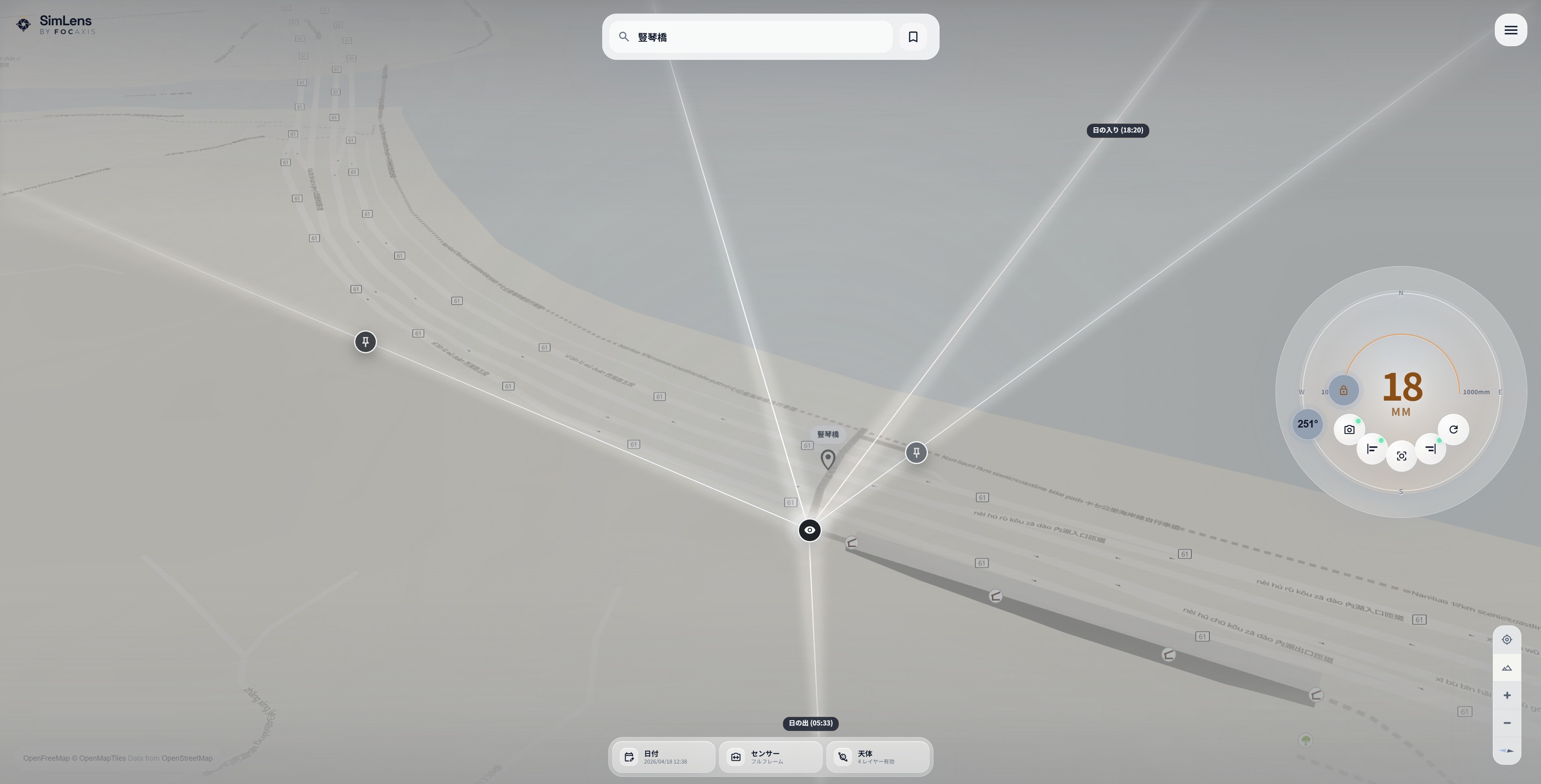
With SimLens, we can first mark the shooting position on the map, then use the surrounding terrain and road layout near Harp Bridge as references to adjust the viewing direction and field of view. Once the angle of view is locked, the system can reverse-calculate the focal length needed to reproduce a composition close to the original photo, based on the geometric relationship between the main viewpoint and the reference points. In this case, SimLens estimates the focal length to be around 18mm, which explains why the photo is able to preserve the strong near-to-far perspective of the bridge, the broad sweep of traffic trails, and the spacious feeling of the coastline and sky.
The most practical value of this feature is that photographers do not have to wait until they arrive on location to realize that the lens they brought is not wide enough. For landscape photographers planning to shoot bridges, city nightscapes, traffic trails, coastlines, or expansive scenes, SimLens can help estimate in advance whether a location calls for something around 18mm, 24mm, or an even wider ultra-wide-angle lens. In other words, it is not only a tool for analyzing existing photos, but also a practical aid for pre-shoot location scouting, gear planning, and composition prediction.
In addition, the SimLens screen also shows sunrise and sunset direction guide lines extending from the main viewpoint. Based on the shooting location and selected date, the system calculates the direction in which the sun will rise and set that day. This is especially useful for golden-hour and blue-hour photography, because the relationship between bridges, roads, mountain or coastal lines, and the sun’s position often determines whether the image can achieve the desired layers of light and shadow. By combining focal length simulation with sunrise and sunset azimuth prediction, photographers can plan their composition, lens choice, and lighting conditions before they even head out.