Photographing the Liyutan Reservoir Sawtooth Weir with an Ultra-Wide-Angle Lens
The sawtooth weir at Liyutan Reservoir is an ideal example of a landscape scene that truly benefits from an ultra-wide-angle lens. From the shooting position in front of the weir, the frame needs to include the flowing water in the foreground, the repeated structure of the weir, the open reservoir surface in the distance, and the surrounding hills and sky. With a narrower lens, the scene can easily feel cropped or incomplete. An ultra-wide perspective, however, allows the entire sense of scale and depth to be preserved in a single frame

The real challenge in this kind of landscape photography is not simply deciding whether to use a wide-angle lens, but knowing exactly how wide the lens needs to be. In this Liyutan Reservoir example, both sides of the scene play an important role in the composition. If either side is excluded, the symmetry of the weir and the spacious feeling of the reservoir become weaker. This is where SimLens becomes useful: by marking the main viewpoint and the left and right edges of the intended frame on the map, photographers can estimate the required angle of view and equivalent focal length before going to the location
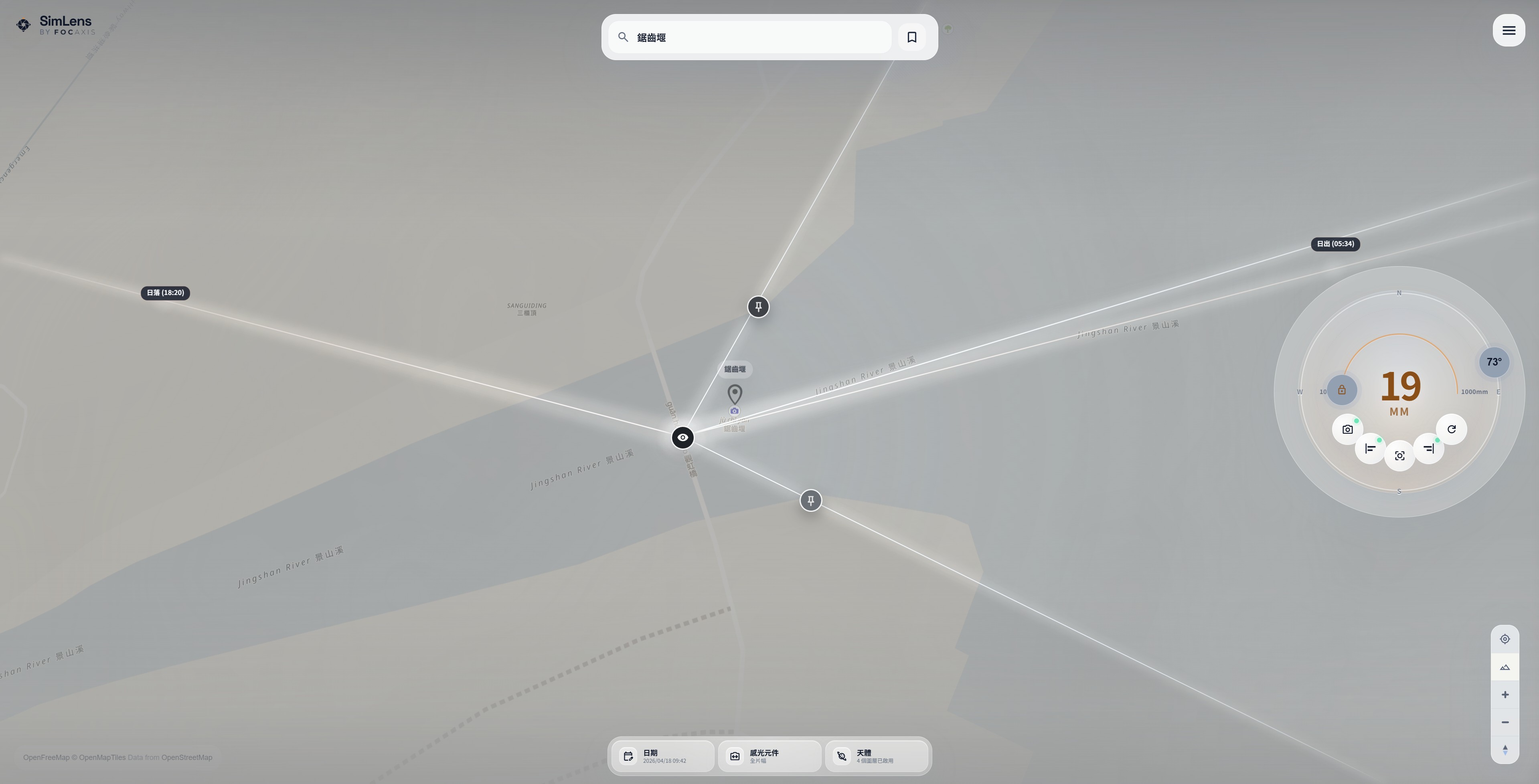
In the SimLens simulation, covering the sawtooth weir, the reservoir surface, and the hills on both sides from this position requires an ultra-wide field of view of around 19mm. This explains why a standard zoom lens may feel too tight in such a location. The issue is not always that the photographer cannot step back far enough, but that the scale of the scene itself demands a wider perspective. With this workflow, focal length becomes more than a number on a lens; it becomes a condition that can be checked and verified through the relationship between map, viewpoint, and composition
For landscape photographers, the greatest value of pre-visualization is reducing the risk of arriving on location only to discover that the lens is not wide enough. Large-scale scenes such as reservoirs, bridges, valleys, and coastlines often depend heavily on the match between shooting position and focal length. SimLens does not replace on-site judgment, but it helps photographers understand the required framing, angle of view, and lens choice in advance. Once on location, they can focus more on light, clouds, water movement, and the decisive moment of pressing the shutter